Podcast: Play in new window | Download
Subscribe: Apple Podcasts | RSS
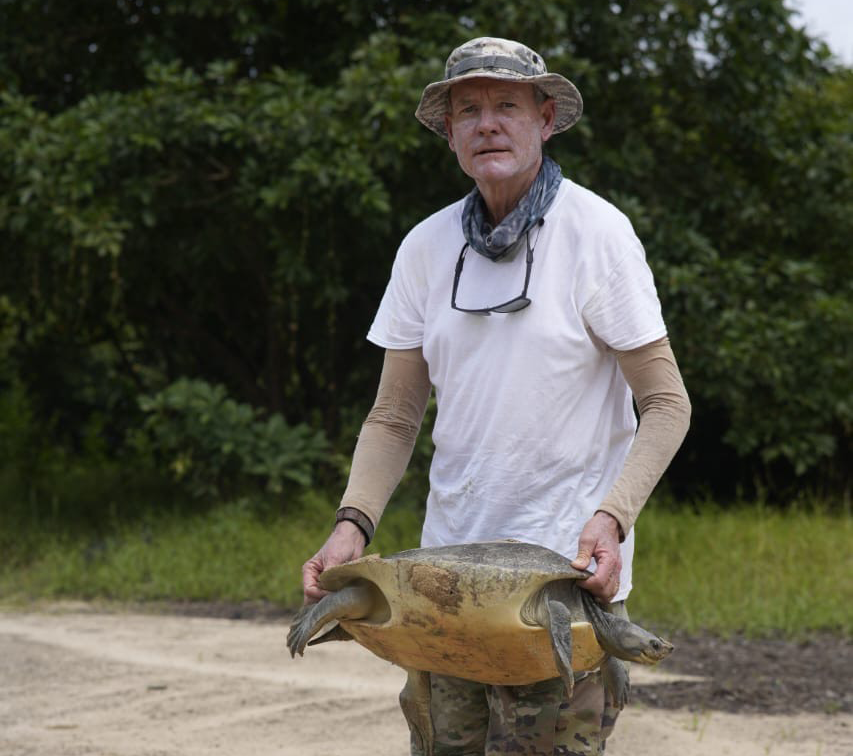 Dr. Steven Platt is a Wildlife Conservation Society (WCS) Herpetologist for Southeast Asia. He received his BSc. in Forestry and Wildlife Management from Louisiana State University, his MSc. in Biology from Southeastern Louisiana University, and his PhD in Zoology from Clemson University. Afterwards, Steve worked for WCS from 1996 – 2001. In 2001, Steve transitioned to working in academia. He served on the faculty at Oglala Lakota College in South Dakota for about five years, followed by five years as a faculty member at Sul Ross State University in Texas. In 2011, he accepted his current position and returned to WCS. In this interview, Steve shares more about his life and his work in research and conservation.
People Behind the Science Podcast Show Notes
Life Outside of Science (2:23)
When he’s not working, Steve spends his time reading, going for walks outside, birdwatching, and hunting. He also used to raise chickens as a hobby. Birdwatching is a particular passion, and he aspires to one day see an ivory-billed woodpecker in the wild.
The Scientific Side (3:52)
Steve is a crocodile and turtle biologist who studies these animals in the field and in captivity. Many species of crocodiles and turtles are endangered, and Steve is dedicated to better understanding and conserving them.
A Dose of Motivation (4:57)
“Endeavor to persevere.” — Chief Dan George (playing Lone Watie) in the 1976 film The Outlaw Josey Wales
“You may ask of me anything but time.” — Napoleon Bonaparte
What Got You Hooked on Science? (9:02)
Though he can’t remember exactly when he got interested in biology and wildlife, Steve was an avid reader from an early age. He particularly enjoyed books written by the famous field biologist George Schaller. Steve believes that his passion for science and field work may trace back to his genes since his biological mother was also a wildlife biologist, though he didn’t meet her until later in life. As a kid, Steve spent a lot of time outdoors exploring local creeks and ponds, and catching turtles and snakes.
When thinking about potential careers, Steve briefly considered becoming a veterinarian, but quickly realized in college that this wasn’t the fit he was looking for. He switched his major to forestry and wildlife management and never looked back. Steve studied alligators during his masters degree and then did an internship researching crocodiles in Australia. During his PhD, Steve worked on a crocodile species in Belize, and this was his first time working with the Wildlife Conservation Society (WCS). These projects and the people he met opened doors to even more great opportunities. After a decade in academia, Steve returned to WCS and continues to lead important work conserving crocodiles and turtles in Asia.
The Low Points: Failures and Challenges (21:09)
Towards the end of 2016, Steve was working with an excellent team in Myanmar, and there was a large confiscation of big-headed turtles. These turtles are delicate, and they were in terrible condition when they were discovered. Steve was away doing field research at the time, but when he heard the news, he rushed back to help. Despite the best efforts of Steve’s team and the expert veterinarians from around the world who joined them, many of the turtles could not be saved. They were overwhelmed with the sheer number of turtles (about 1,000) and the amount of care they required. Losing so many animals was heartbreaking and demoralizing. However the team met with the Forest Department and established rigorous new protocols that quickly proved their worth in the next large confiscation event, where the survival rates were much higher.
A Shining Success! (26:06)
Steve works with really talented colleagues, and they’ve had some very encouraging successes. In Myanmar, the Star Tortoise was effectively extinct in the wild by 2001. Working with the Forest Department there, they began breeding the tortoises in captivity. The captive breeding program really took off when Dr. Kalyar Platt, Steve’s wife, began leading these efforts. From the initial 175 animals that they started with, they now have about 12,000-14,000 animals in captivity. Even more exciting is the fact that their work to reintroduce these tortoises in wildlife sanctuaries has been highly successful.
Their work on the Burmese Roofed Turtle is another meaningful success. From fewer than 25 known turtles combined in the wild and captivity, new populations have been discovered. A captive breeding program was established, and it has been really rewarding to see these turtles hatch and then later be reintroduced in the wild. This project hasn’t been without challenges, but saving these animals from likely extinction has been a major achievement.
Book Recommendations (32:58)
Grizzly Years: In Search of the American Wilderness by Doug Peacock, The American Chestnut: An Environmental History by Donald Edward Davis, The Sounds of Life: How Digital Technology Is Bringing Us Closer to the Worlds of Animals and Plants by Karen Bakker, any book by George Schaller.
Most Treasured Travel (35:23)
One place that Steve absolutely loves is Belize. He met some wonderful people in the country during the early stages of career, and he really loved his time working on crocodiles there. Another place that tops Steve’s list is Myanmar. His wife and children are Burmese, and they have a big family there. Residents around Steve’s field sites have stopped him in the streets to take photos because international visitors are so rare. The people there are incredibly friendly too. For example, he was treated to tea and local food by one woman and her husband when they heard about him staying in the village. Professionally, the biodiversity in Myanmar is remarkable, and there is still so much to learn about the turtles and crocodiles there.
Quirky Traditions and Funny Memories (38:47)
When Steve and a close colleague worked together in Belize, they had many unforgettable adventures catching crocodiles at night. A lot of work goes into making arrangements to go out on the boat to collect the animals, and some nights they didn’t manage to catch any. This inevitably led them to become very superstitious. After a really successful night, they often tried to use the same pole and the same snare on the next outing to hopefully boost their luck. Logically, they knew this made no difference, but it became a tradition.
Steve also used to bring his dog named Trouble on their expeditions, and Trouble was great at tracking down turtles. They spent 18 years together and shared a lot of wonderful memories. On one occasion, Steve took a boat of tourists staying at the local lodge out with him to catch crocodiles. The group caught a particularly large crocodile that night and struggled mightily to get it on the boat. Between Trouble’s barking, concerned tourists, and an even more concerned lodge manager, there was quite a scene. This was the origin story of the “Rambo scale” of chaos that became an inside joke between Steve and his colleague.
Advice For Us All (45:02)
Sometimes, you really need to focus. It can be easy to get distracted by tangents, but maintaining focus and making progress on your core projects is critical, particularly in the early stages of your scientific career. At the same time, follow your interests. While you may not make a ton of money as a field biologist, it is a fun, rewarding, and immensely interesting career. Pursue work that you are passionate about because you are going to spend most of the waking hours of your life working. And finally, remember that conservation is very important, and it’s not necessarily a losing battle. There are many inspiring conservation success stories, and we can still make a difference and prevent species from going extinct.
Guest Bio
Steve’s early research spanned the ecology of Morelet’s crocodile (Crocodylus moreletii) and a nationwide survey of the endangered American crocodile (Crocodylus acutus) in Belize. Since then, he has worked for WCS on crocodile and turtle conservation in various countries in Southeast Asia, including Myanmar, Cambodia, Thailand, Laos, and China. He spent a decade working in academia before returning to Myanmar to continue conservation work with his wife Dr. Kalyar Platt. In Myanmar, Steve has been involved in efforts to reintroduce Burmese Star Tortoises (Geochelone platynota) into protected areas and work along the upper Chindwin River to save the Burmese Roofed Turtle (Batagur trivittata) from extinction. He has also played an important role in the Cambodia Program on Southern River Terrapin (Batagur affinis) and Siamese crocodile (Crocodylus siamensis) conservation. In China, Steve has been reintroducing and monitoring Chinese alligators (Alligator sinensis) with Professor Lu Shunqing. He has co-authored numerous scientific papers on crocodilians and turtles over the years. In his free time, you can find Steve reading, travel, bicycling, and enjoying the outdoors on walks.
Leave a Reply