Podcast: Play in new window | Download
Subscribe: Apple Podcasts | RSS
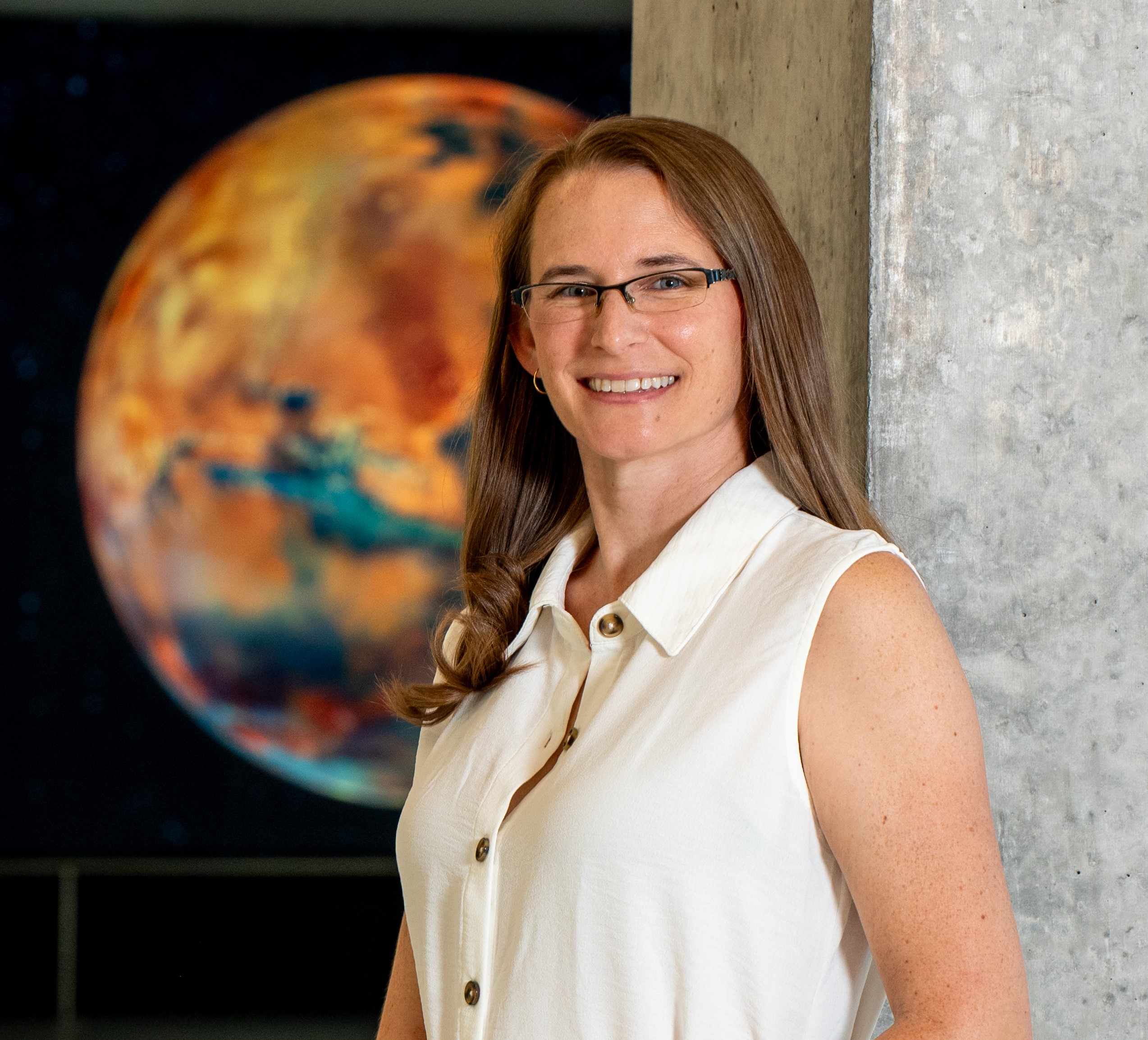
Dr. Amy Williams is an Associate Professor in the Department of Geological Sciences and Assistant Director of the Astraeus Space Institute at the University of Florida. Amy received her B.S. in Earth & Environmental Science from Furman University, her M.Sc. in Earth and Planetary Sciences from the University of New Mexico, and her Ph.D. in Geology from the University of California, Davis. Afterwards, Amy accepted a position as a Postdoctoral Research Associate at the NASA Goddard Space Flight Center. She served on the faculty at Towson University before joining the faculty at the University of Florida in 2018. She has received several NASA group achievement awards for her work with the Curiosity and Perseverance rover teams, and she was awarded the Provost’s Excellence Award for Assistant Professors from the University of Florida. She received the American Geophysical Union’s Award for Advancing Inclusive Excellence in STEM with the GeoSPACE Field Program, and she was a NASA Earth and Space Science Fellow and a Scialog: Signatures of Life in the Universe Fellow. In this interview, Amy shares more about her life and science.
People Behind the Science Podcast Show Notes
Life Outside of Science (2:40)
When she’s not working, Amy enjoys spending time with her family and her cats. Some of her favorite pastimes include birdwatching, hiking, walking, and gardening.
The Scientific Side (3:54)
Amy is an astrobiologist who builds instruments and analyzes data from other worlds to help us try to answer the question of whether there is life on other planets beyond Earth. She is particularly interested in investigating whether there was once life on Mars.
A Dose of Motivation (5:16)
“You gain strength, courage and confidence by every experience in which you really stop to look fear in the face. You must do the thing you think you cannot do.” — Eleanor Roosevelt
What Got You Hooked on Science? (8:02)
Growing up, Amy’s family regularly discussed science and technology and encouraged her curiosity. She’ll never forget laying in the back of her parents’ pickup truck one night watching a meteor shower streak across the sky. This experience sparked a lot of questions in her mind and helped cement her interest in exploring the possibility of life beyond Earth. Amy started as studying biology when she entered college, but she quickly switched her major after taking her first geology course. With the help of an influential undergraduate mentor, Amy got involved in research on water chemistry and published her first academic research paper.
As she continued her research on water-limited landscapes in New Mexico during her master’s program, Amy began examining connections between geology, chemistry, water, and microbial life. As her interests evolved, she shifted to geobiology and ultimately astrobiology. During her PhD at the University of California, Davis, Amy joined NASA’s Curiosity rover mission before its launch and has continued working on the mission throughout her career. She completed a research-intensive postdoctoral fellowship and also developed her skills as an educator before pursuing academic faculty roles. Serendipity, luck, hard work, and preparation were key along the course of Amy’s career path.
The Low Points: Failures and Challenges (26:15)
Failure is an unavoidable part of science, particularly when working with instruments operating millions of miles away on another planet. Right before they were supposed to begin collecting data on Mars for a new experiment designed to detect and analyze organic carbon, a critical channel in the instrument became clogged. Amy and her team had to abandon much of their original preparation and rapidly pivot to using an alternative channel they had never used before.
Through adaptability, collaboration, and the expertise of scientists and engineers at NASA Goddard, the Jet Propulsion Laboratory, and partner institutions in France, they transformed a potential failure into a major success and collected really cool new data. The experience reinforced the importance of trusting experienced collaborators, remaining flexible when plans have to change, and finding a way to turn a challenge into an opportunity.
A Shining Success! (29:56)
A major recent success for Amy was the first-of-its kind experiment using NASA’s Curiosity rover to understand whether the organic carbon found in Martian rocks came from living organisms, geological processes, or meteorites. The relatively simple molecules they detected most closely resembled organic material found in meteorites, suggesting that at least some of the carbon may have arrived on Mars billions of years ago and remained preserved in the rocks. While the findings do not provide evidence of life, they add an important piece to the larger story of whether ancient Mars contained the ingredients and conditions necessary for life.
The paper represented the culmination of 12 years of work that began when Amy joined the Sample Analysis at Mars (SAM) instrument team as a postdoctoral researcher in 2014. The experiment was conducted during the pandemic, which introduced many logistical challenges. Since then, the team completed extensive data analysis and laboratory studies to ensure that their conclusions were robust.
Mentoring students is also a source of meaningful successes for Amy. One student in her lab recently defended his master’s thesis, and he’s staying in the lab to complete a PhD. Beyond these big milestones, helping students overcome everyday challenges in the lab and learning to navigate failure is a valuable part of Amy’s career.
Book Recommendations (35:09)
The Sirens of Mars: Searching for Life on Another World by Sarah Stewart Johnson
Most Treasured Travel (36:37)
Through her career, Amy has had many fantastic opportunities to travel, explore new cultures, and build collaborations around the world. In recent years, she has conducted fieldwork in Iceland, collecting samples from hydrothermally influenced lakes that may resemble ancient lakes on Mars. Iceland has become a home away from home for Amy, and it’s been amazing to explore the wild landscapes, volcanoes, and waterfalls; see the rapidly changing weather firsthand; and experience the nearly endless daylight in the summers there.
Another memorable trip brought Amy to Abu Dhabi in the United Arab Emirates for a symposium at New York University Abu Dhabi. During her visit, Amy was delighted to connect with researchers she likely wouldn’t otherwise have had the opportunity to meet. Though it was a quick trip, Amy was impressed by what she saw of the city.
Quirky Traditions and Funny Memories (40:22)
Amy’s husband is also a planetary scientist and faculty member at the same university, so they get to see each other both at home and at work. His lab uses large presses that can crunch down geological material with high pressures. The presses are decorated with little figure offerings meant to appease them and encourage them to continue working well. Inspired by this tradition from other labs, a student in Amy’s lab brought in a little plastic dinosaur glued to a rock. The dinosaur now watches over everyone as they use the instruments in the lab.
Amy’s lab also has a special tradition to commemorate each time a master’s or PhD student defends their thesis. She hangs one of the flyers about their presentation on the back of her office door and has them sign it. This serves as a nice visual reminder of all of the students she has trained, and Amy hopes to completely cover the door before she retires.
Advice For Us All (45:05)
This too shall pass. Remember that difficult times will give way to brighter days, but also that exciting discoveries and accomplishments are steps along your journey that will come and go. Keep moving forward and strive to make a positive difference in the lives of family, trainees, colleagues, and communities at home and around the world. And take a moment to reflect on the vastness of the universe and the possibility of life beyond earth. In the wise words of Dr. Carl Sagan, “the universe is a pretty big place, and if it’s just us, it seems like an awful waste of space.”
Guest Bio
Amy’s research is focused on the search for life beyond Earth by working with NASA’s Mars Curiosity and Perseverance rovers. She works with instrument development and existing flight instruments on planetary missions, as well as conducting analog environment studies on Earth to optimize existing and future life-detection instruments and missions. Most recently she has been sharing her research time between working on the Mars rover missions, conducting field work in Iceland, and irradiating ice cores that mimic the icy outer ocean moons of Enceladus and Europa. Beyond the lab, Amy enjoys building lego sets, gardening, reading, and relaxing with her husband, son, and 3 cats (the cats are less helpful with the legos than they think).
Leave a Reply