Podcast: Play in new window | Download
Subscribe: Apple Podcasts | RSS
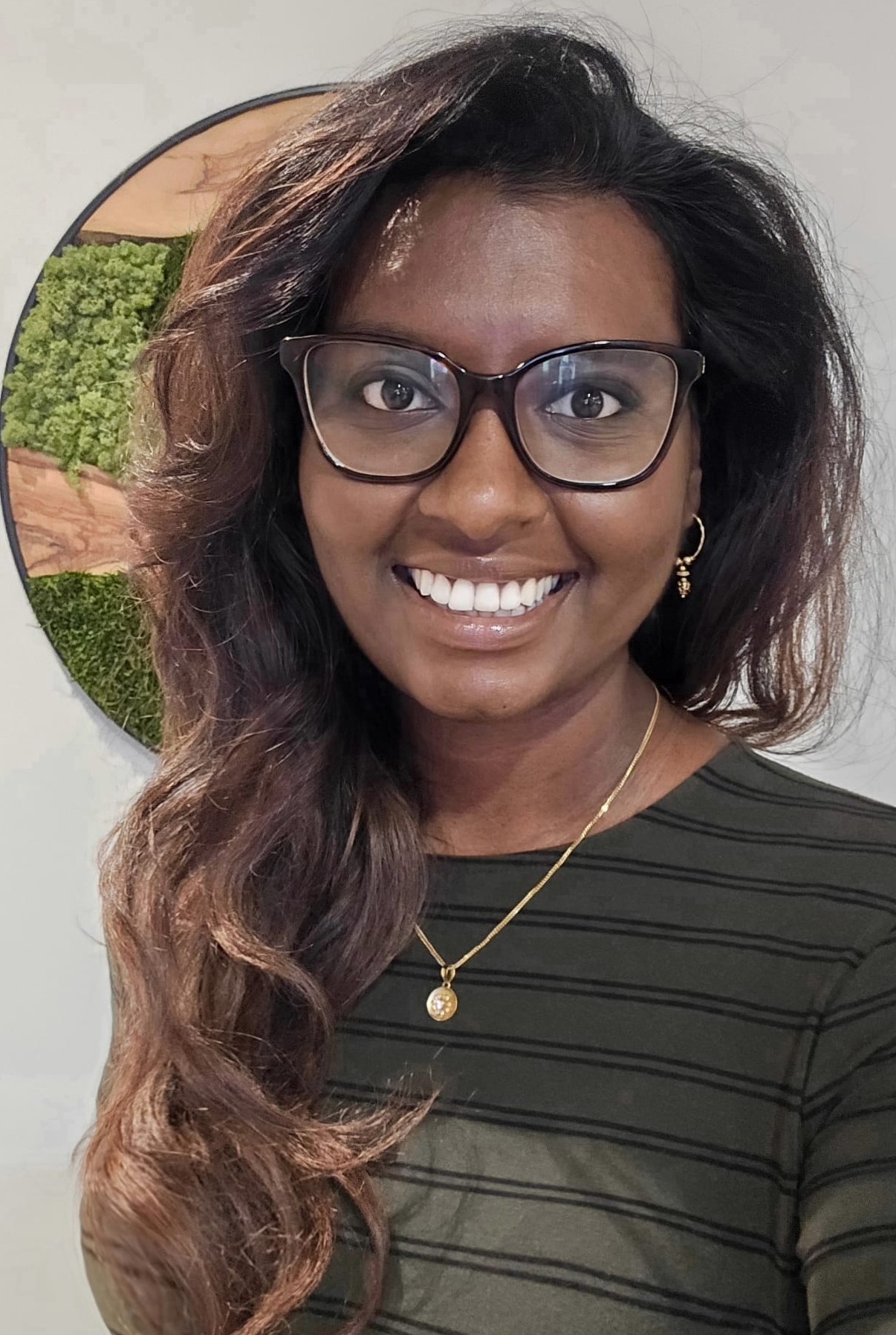 Dr. Nirosha J. Murugan is a Tier II Canada Research Chair in Tissue Biophysics as well as Distinguished Research Chair and Assistant Professor in the Department of Health Sciences at Wilfrid Laurier University. She was awarded her B.S. in behavioral neuroscience, her M.S. in biophysics, and her PhD in biomolecular sciences from Laurentian University. Afterwards, she conducted postdoctoral research at the Allen Discovery Center at Tufts University. During that time, she also served as a teaching fellow at Harvard University in the Department of Molecular and Cellular Biology. She served on the faculty at Algoma University before joining the faculty at Wilfrid Laurier University in 2024.
Over the course of her early career, Nirosha has received numerous awards and honors including the Early Researcher Award from the Ontario Ministry of Development and Innovation. She was also the recipient of Rising Awards of Excellence from the Government of Ontario, the Young Professional Visionary Award from the Sault Ste Marie Chamber of Commerce, and an Optica Foundation Award to develop new optical tools to solve global health challenges. In this interview, Nirosha shares more about her life and science.
People Behind the Science Podcast Show Notes
Life Outside of Science (2:41)
Outside the lab, Nirosha’s life is shaped by both family and her lifelong passions. Nirosha loves spending time with her six-year-old daughter and watching her creativity develop. For her own mindset and energy, she practices Olympic recurve archery, a sport she discovered in graduate school as a way to cultivate focus, flow, and skills she can refine across her lifetime. As a recreational pilot, Nirosha fulfills her childhood dream of flying, and she relishes the sense of freedom she gets flying her small four-seat plane.
The Scientific Side (4:54)
Nirosha’s research focuses on how our bodies, cells, and tissues communicate with each other from the molecular scale all the way up to our organs, physiology, and consciousness. She is interested in the kinds of information that are shared, including light, electromagnetic fields, and electricity, as well as the physics of how the information is transmitted. Her lab develops tools to record biophysical signals and also tools to help reprogram these signals back to a healthy state when something goes wrong in diseases like cancer.
A Dose of Motivation (6:04)
“Wounds are a portal for our light to interact with our bodies and our environment.”
What Got You Hooked on Science? (11:40)
The origins of Nirosha’s scientific curiosity can be traced back to her childhood fascination with how the body works. Her grandfather, a general practitioner doctor, played a major role in supporting and encouraging Nirosha’s curiosity. He shared his medical knowledge and books with her, and he also engaged her in conversations that bridged medicine and spirituality. Those discussions planted an early seed for interdisciplinary thinking and led Nirosha to deeply consider experiences like spirituality and religion.
As she became more interested in the brain, Nirosha wanted to know how to address problems with mental health and personality disorders that weren’t readily visible or tangible like many of the conditions her grandfather treated. During her undergraduate training, Nirosha got involved in behavioral neuroscience research, and working with Dr. Michael Persinger was life-changing. His integrative approach spanned neurochemistry, neuropharmacology, neuroanatomy, and psychological assessment, and it gave her a systems-level view of how the brain computes information and produces behavior.
Over time, Nirosha began to feel that purely molecular or chemical explanations were incomplete. They couldn’t fully explain the variability of human experience, such as differences in sleep and behavior. This led her to physics. In particular, biophysics brings together molecular biology and basic principles from physics in ways that can start to better examine how the brain and body generate experience.
The Low Points: Failures and Challenges (24:50)
Failures come in many forms in science, including everyday problems like equipment breaking mid-experiment, or forgetting to save your data and losing a full day of work. These kinds of things happen to everyone and are part of doing research. Beyond the day-to-day setbacks, working at the intersection of optics, photonics, and biology means navigating gaps in expertise and language between different scientific communities. Physicists and biologists often speak very different “languages,” and translating between them has been an ongoing challenge. However, this is also a great learning opportunity and a chance to build better shared frameworks and tools. Even within her own lab, it’s been important to find people with diverse expertise and help them learn to communicate with each other. This is a work in progress that Nirosha is continuing to figure out alongside her team.
A Shining Success! (27:10)
One of the things Nirosha is most proud of is seeing her trainees build confidence and carve their own paths. This is particularly the case for individuals in her lab who felt underrepresented or unsure they had the “right” background. It is really rewarding when she can help these individuals recognize their strengths, develop novel ideas, and ultimately land in outstanding programs at major research institutions.
Another really meaningful success was the publication of a recent paper in Cell Metabolism with her partner and collaborator, Dr. Martin Picard. This paper introduced a new energy-based framework for understanding the body and physiology. While the paper itself was a major milestone, the impact is also important. Nirosha is committed to communicating these ideas beyond academia so non-scientists can understand and apply them in their own lives. To celebrate this victory, Nirosha and Martin went out to dinner and took a moment to appreciate this achievement and its potential impacts.
Book Recommendations (30:54)
Matrescence: On Pregnancy, Childbirth, and Motherhood by Lucy Jones; The Tao of Physics by Fritjof Capra.
Most Treasured Travel (32:45)
Earlier this year, Nirosha and a small, international group of researchers interested in quantum biology gathered near Florence, Italy. This provided opportunities to connect with others who are curious about understanding life and biology through the lens of quantum physics. The meeting was energizing, encouraging, and a rare opportunity to openly explore ideas that don’t always fit neatly into traditional scientific silos.
The trip was also memorable for other reasons. While traveling to Italy, Nirosha’s luggage was lost, and all she had for the week-long conference was the casual outfit she was wearing. Despite the inconvenience, Nirosha enjoyed light hikes and explorations of the beautiful town of Lucca, which had perfect weather and gorgeous mountains. When Nirosha found out her flight home was cancelled, she had to quickly make alternative arrangements. Despite the chaos, her visit to Italy was a fun and professionally valuable experience.
Quirky Traditions and Funny Memories (35:39)
Each year, Nirosha’s group holds a “Lab Olympics.” This event involves turning everyday, low-cost lab equipment into a variety of creative and competitive games. Complete with homemade gold, silver, and bronze medals made from Petri dishes, the event brings everyone together to bond outside of their everyday research activities. “Pipette javelin” is Nirosha’s favorite event, and it involves precisely ejecting pipette tips to land in a bucket across a table. Beyond the laughs and bragging rights for the winners, this tradition fosters community and helps create a space where everyone feels human, connected, and comfortable sharing even their wildest ideas.
Advice For Us All (39:30)
If you’re not going to apply for an opportunity, someone else will. Why not try? Also, don’t be afraid to be different, weird, or unconventional. It can be challenging to be different, but being different can be an asset, and thinking differently can lead to new discoveries. In the context of research funding, branching out into different funding sources is important to think about as well.
Guest Bio
Nirosha is an applied biophysicist whose work explores how patterned physical signals, such as light and magnetism, govern cellular plasticity, tissue regeneration, and the reprogramming of disease states. Her approach reframes biology not solely as a molecular system, but as a dynamic network governed by first principles in physics. Her lab bridges quantum mechanics and biophysics with biomedical engineering to decode how physical signals, acting as carriers of structured information, sculpt the body’s energetic architecture. By mapping how these signals define energy landscapes and reconfigure cellular signaling networks, her work reveals new ways to understand cell state transitions, disease emergence, and therapeutic responsiveness at both the individual and systems level. Outside of research, Nirosha’s passions include archery, flying as a recreational pilot, and spending quality time with her daughter. Get connected with her on X or LinkedIn, and visit her lab website to learn more.
Leave a Reply