Podcast: Play in new window | Download
Subscribe: Apple Podcasts | RSS
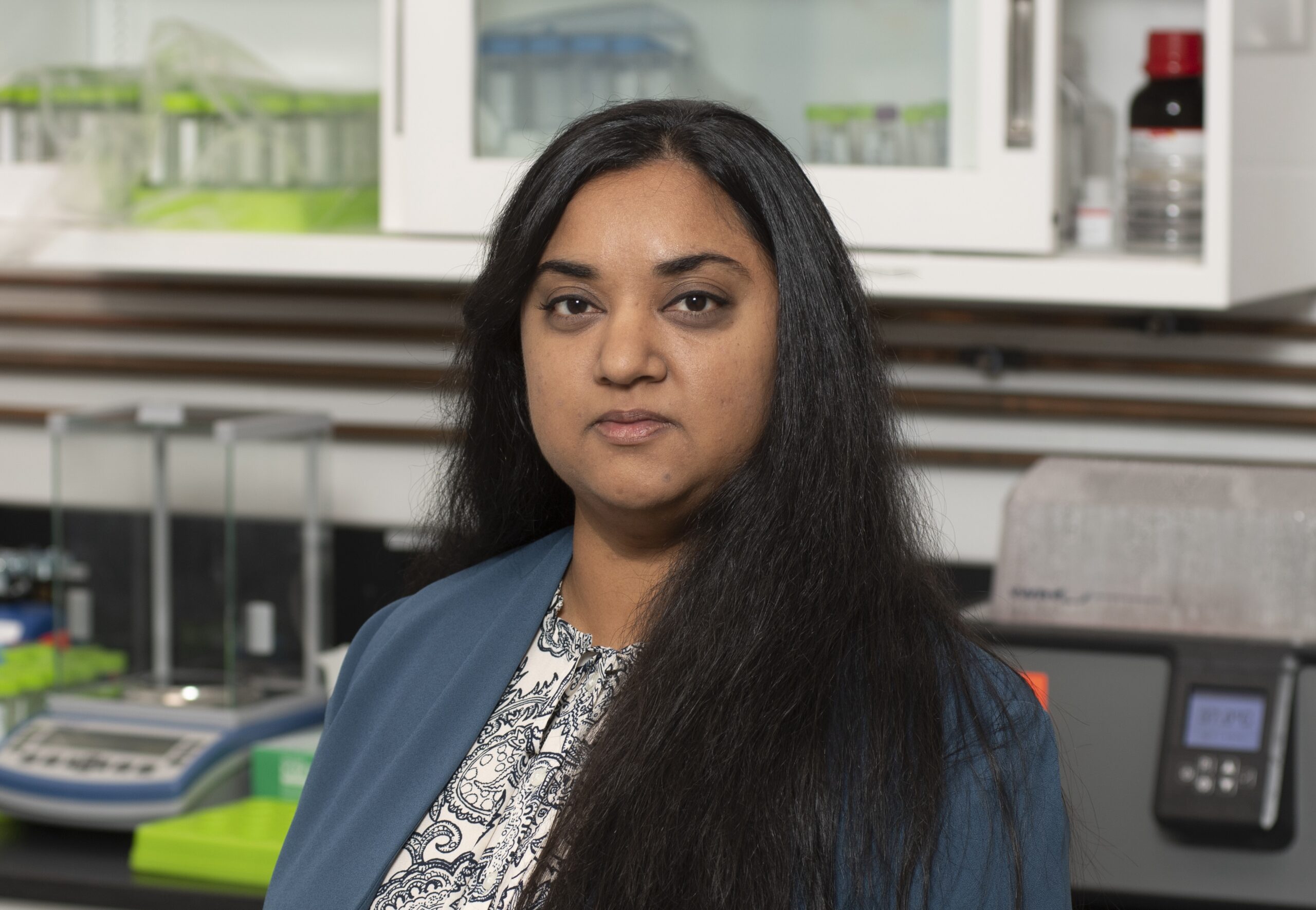 Dr. Meenal Datta is the Jane DeFlorio Collegiate Professor and associate professor of Aerospace and Mechanical Engineering at the University of Notre Dame, where she directs the Tumor Immune Microenvironment & Mechanics (TIME) Lab. She received her BS in chemical engineering from the University of Massachusetts Amherst and her PhD in chemical and biological engineering from Tufts University. She completed her predoctoral and postdoctoral training at Harvard Medical School and Massachusetts General Hospital under Dr. Rakesh K. Jain, before joining the faculty at Notre Dame in fall 2021. She has been recognized with numerous honors and awards including the National Science Foundation CAREER Award, the Biomedical Engineering Society’s Rita Schaffer Young Investigator Award, the Air Force Young Investigator Program Award, the Cellular and Molecular Bioengineering Young Innovator Award, a Rising Star award from the American Society for Mechanical Engineers and a Maximizing Investigators’ Research Award for early stage investigators from the National Institutes of Health. In this interview, she shares more about her life, career, and research.
People Behind the Science Podcast Show Notes
Life Outside of Science (2:57)
Outside of science, Meenal enjoys taking walks around the beautiful campuses near Notre Dame while listening to podcasts and audiobooks. A recreational rower since high school, she also rows a few times a week with the South Bend Community Rowing Club. When the Midwest weather keeps her indoors, she enjoys reading, cooking, and unwinding with sci-fi or true crime.
The Scientific Side (6:00)
Her research focuses on the physics of cancer. She examines how the mechanical forces generated as solid tumors grow can influence disease progression, treatment resistance, and the ability of immune cells to fight cancer. Her lab studies how these forces affect both cancer and immune cells within and around tumors. More recently, her team has expanded this work to explore larger physical forces, including gravity, and how they can be harnessed to study cancer and develop new treatments.
A Dose of Motivation (8:44)
“Ad astra per aspera.” (“To the stars through difficulties.”)
What Got You Hooked on Science? (9:50)
Growing up in an academic family, Meenal was exposed early to both education and engineering, but it was her undergraduate research experience at UMass Amherst that showed her she could combine her interests in engineering, medicine, and the human body. Working on a bioengineering project that involved packaging cells to transplant as a potential treatment for diabetes got her excited about doing research. Based on this, she decided to pursue graduate school and a research career instead of medical school.
After struggling to find the right research lab and being encouraged to consider leaving with a master’s degree, a chance connection with Dr. Rakesh Jain changed the direction of Meenal’s career. Beginning with a small math-based project and eventually progressing through her PhD and postdoctoral training, his mentorship helped build her confidence as a researcher. In her work with Rakesh, she used innovative bioengineering approaches to develop treatments for tuberculosis. As she was preparing to launch her own independent research lab, Meenal wanted to return to her engineering roots, so she developed a research program focused on the physics of cancer and the immune system.
The Low Points: Failures and Challenges (33:00)
One of the biggest challenges in Meenal’s career came during her first years of graduate school, when she questioned whether she belonged in research at all. However, even now as a faculty member, she still experiences failures. Meenal and her lab were excited to launch their first experiment into space. This project examined the effects of microgravity on cancer using brain tumor organoids. After a lot of preparation and work designing a setup small enough to fit in their allotted compartment at the International Space Station, everything seemed to be coming together. The launch went well, and they eagerly awaited the return of their samples.
When the samples came back, the lab was disappointed to see that organoid after organoid had not survived. However, the few that were embedded in a brain-like hydrogel survived. Sending a few samples with this hydrogel structural support was something Meenal had convinced the group to do, and it paid off. Discovering that this physical support was necessary changed how they designed future experiments. For their next space experiment, they used the hydrogels for all of their patient-derived brain tumor organoids, and about 80% of them survived. This was a big success, and it has paved the way for further research in this area.
A Shining Success! (37:55)
For Meenal, scientific success comes in many forms. Seeing a student generate promising new data and watching an experiment launch into space aboard a rocket are some of the many successes that Meenal celebrates. One thing Meenal is particularly excited about is that two lab members were participating in a parabolic flight in Switzerland with tumor organoids. They planned to compare how the brief periods of weightlessness experienced during the flight affected these tumor organoids and how this differed from their experiments in the lab and aboard the International Space Station.
The successes of her trainees are also particularly meaningful. Meenal was proud to have her first PhD student graduate a few months ago. The student’s dissertation work connected cancer, physics, and the immune system, and she was involved in the lab’s early work on how different gravity environments can affect tumors.
Book Recommendations (4:30)
Everything Is Tuberculosis: The History and Persistence of Our Deadliest Infection by John Green
Most Treasured Travel (40:18)
Some of Meenal’s most memorable travel experiences have come through Notre Dame’s research and education partnerships in Ireland. She has particularly enjoyed building collaborations with cancer researchers at the University of Galway. There, she is working with researchers using complementary physics- and mechanics-based approaches to better understand cancer.
Trips to Ireland have also given her opportunities to explore the country, including the Cliffs of Moher, Dublin, and Kylemore Abbey in Connemara, where Notre Dame hosts research and educational programs. Her experiences at Kylemore Abbey have been among the highlights of her career so far.
Quirky Traditions and Funny Memories (43:26)
Meenal’s lab has developed plenty of traditions and inside jokes, from naming a cryogenic tank in the lab “Mr. Frosty” to having fun with questionable stock photos of scientists pretending to do research. The bad stock photos have become a recurring part of the lab’s undergraduate research symposium, where students often include the same kinds of silly images in their presentations. They’ve even begun to Photoshop themselves into the photos, which is also hilarious. These lighthearted moments are part of the welcoming and inclusive lab culture Meenal has developed. She especially wants undergraduates to feel like they can contribute meaningfully to the team’s scientific mission.
Advice For Us All (47:48)
Dream big, take risks, and don’t be afraid of failure. Scientific careers rarely follow a straight path, and being open to reinvention can lead to unexpected opportunities. In Meenal’s career, moving from chemical engineering into mechanics, physics, and space-based research required taking chances and embracing unfamiliar areas. Believing in yourself, staying open to new ideas, and being willing to take big leaps can lead to unexpected and rewarding opportunities in science.
Guest Bio
Meenal has built an internationally recognized research program at the intersection of cancer, immunology, mechanobiology, and space biomedicine. Her lab is particularly interested in understanding how physical forces and mechanical environments influence cells and tissues in health and disease. Much of her work focuses on cancer, including glioblastoma, an aggressive form of brain cancer, and on the interactions between tumor cells and the immune system. Her group develops advanced three-dimensional tissue and organoid models to study these questions and to explore new approaches for testing potential therapies.
More recently, Meenal has also been extending this work beyond Earth. Her team studies how the unusual environment of space, particularly microgravity, can be used both to better understand human biology and disease and as a new platform for biomedical research and drug development. This has included sending patient-derived cancer organoids to the International Space Station, and her work has been featured by ABC, NBC, PBS, NPR, and other national media outlets. Outside of the lab, Meenal enjoys rowing, reading, traveling, socializing, and all things sci-fi. She is also an enthusiastic advocate for making science and engineering accessible to students and for encouraging young scientists to pursue unconventional paths and interdisciplinary questions. Much of what she enjoys about her own career comes from being able to move between fields, learn from people with very different expertise, and work on scientific problems that she never would have imagined studying when she first became an engineer.
Support for this episode of People Behind the Science was provided by Innovative Research, Inc.
Leave a Reply