Podcast: Play in new window | Download
Subscribe: Apple Podcasts | RSS
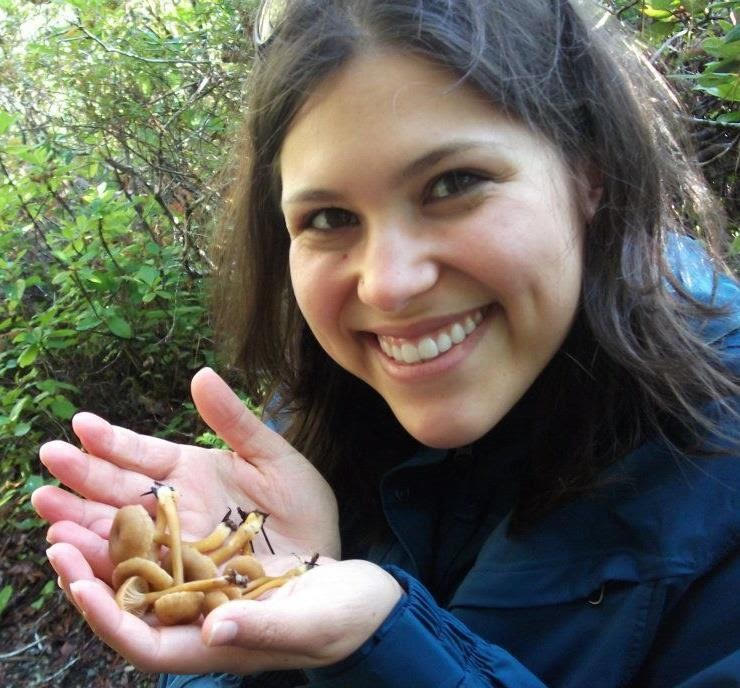 Dr. Sydney Glassman is an Associate Professor in the Department of Microbiology & Plant Pathology at the University of California, Riverside. She completed her B.A. in Biology with a Concentration in Ecology and Evolutionary Biology at the University of Pennsylvania. Next Sydney received a Master’s of Environmental Studies degree in Environmental Biology from the University of Pennsylvania working with Professor Brenda Casper. She was awarded her PhD in Environmental Science, Policy, & Management from the University of California, Berkeley working with Professor Tom Bruns. Afterwards, she conducted postdoctoral research at UC Irvine working with Professor Jennifer Martiny in the Department of Ecology and Evolutionary Biology before joining the faculty at UC Riverside in 2018. In this interview, Sydney shares more about her life and science.
People Behind the Science Podcast Show Notes
Life Outside of Science (2:17)
Outside of work, Sydney spends most of her time with her husband, her young children, and their two dogs (one an extra-large mixed breed and one an extra-small mixed breed). Reading books together is a favorite family pastime.
The Scientific Side (3:18)
Sydney studies how wildfires affect soil bacteria and fungi, with a particular interest in how soil microbial communities help ecosystems recover after disturbance. Her work focuses especially on mycorrhizal fungi, which form beneficial relationships with plant roots, as well as other fascinating bacteria and fungi that play important roles in nature.
A Dose of Motivation (4:25)
“Mycology without apology.” — Tom Bruns
Sydney also draws inspiration from thinking about why she decided to pursue science, how important fungi are in our lives and society, and her role as a teacher and mentor.
What Got You Hooked on Science? (9:44)
Sydney’s scientific story began with an inspiring AP Biology teacher and a transformative semester at the Mountain School in Vermont. She went from the very urban environment she was used to in Los Angeles to spending time on a farm, understanding where food comes from, and learning how to read the forest landscape. As an undergraduate student, Sydney’s earliest research experiences with mycorrhizal fungi introduced her to the powerful beneficial relationships that shape ecosystems. This set her on a path toward studying fungi.
Later, a study abroad experience in Costa Rica sparked a deeper fascination with mushrooms and confirmed her interest in ecology and mycology. After completing her PhD and a postdoc (where she expanded her work to include bacteria), Sydney launched her own lab studying both fungal and bacterial communities and the important roles they play in the environment.
The Low Points: Failures and Challenges (25:03)
In her research, Sydney uses “pyrocosms,” which are controlled bucket-based fire simulations. They use these pyrocosms to study how soils from different fire-prone ecosystems respond to burns of varying intensity. By comparing soils from chaparral shrublands, grasslands, and coniferous forests, her team has been examining how wildfires affect bacteria, fungi, viruses, nitrogen cycling, and greenhouse gas emissions.
Setting up the pyrocosms for this project required a ton of troubleshooting. She and her lab spent a whole year trying to get these wildfire simulations to have reliable temperature profiles. Another major hurdle for their experiments was that to perform the controlled burns, it couldn’t be raining, it couldn’t be windy, it couldn’t be too hot, and the air quality had to be above a certain threshold. They also battled challenges related to the COVID-19 pandemic, and it was difficult to extract viable samples of DNA and RNA from their burned soils. While all of this was going on, Sydney welcomed her two children into the world. Being persistent, making the best out of difficult situations, and being ready to pivot when needed have helped Sydney make it through some of the toughest times in her career.
A Shining Success! (28:39)
Recently, Sydney was notified that she is this year’s recipient of the C.J. Alexopoulos Prize from the Mycological Society of America, an award that recognizes the most promising young mycologist within 10 years of earning their PhD. This honor was especially meaningful because the Mycological Society of America has long been her favorite professional society, her PhD advisor received the same award decades ago, and she has grown up as a scientist within this community.
Book Recommendations (31:37)
Mistborn series by Brandon Sanderson.
Most Treasured Travel (32:51)
During her PhD, Sydney traveled extensively for her research, including presenting at the International Mycological Congress in Bangkok, Thailand. After the conference, Sydney spent a whole month exploring Southeast Asia, including Thailand, Laos, Vietnam, Cambodia, Singapore, and Malaysia. She enjoyed spending time in nature in the beautiful national parks in Thailand. In Laos, Sydney spent a weekend in a wonderful indigenous community in the jungle, and she was in awe of their knowledge of the local mushrooms, plants, and traditional uses of fungi. Seeing all of the different mushrooms in the markets and how fungi were an important part of daily life in this culture was eye opening.
When she was a PhD student, Sydney also shared her work at a conference in Prague and traveled to Israel to collaborate on research examining how prescribed burns affect soil fungi. Teaching scientists from another part of the world the methods they used for high-throughput molecular sequencing for fungi was a really cool experience.
Quirky Traditions and Funny Memories (35:48)
Science is far more collaborative and social than what many of the common stereotypes portray. During her PhD, Sydney and other fungal biology lab members gathered each year at Point Reyes for a Fungal Labs Beach Trip with a bonfire and picnic. This was a tradition that she decided to bring with her to UC Riverside, and they now hold beach parties at San Clemente Beach.
Advice For Us All (38:28)
Stay resilient, keep moving forward, and learn how to turn failures or setbacks into something positive. It’s also important to recognize that fungi are a vital part of our lives. They are found in everyday things like bread, beer, cheese, and medicine, and they play a critical role in supporting many plants.
Guest Bio
Sydney’s lab examines microbial ecology including arbuscular mycorrhizal and ectomycorrhizal fungi, soil bacteria, and fungi. She is particularly interested in how disturbances such as wildfires impact soil fungal and bacterial microbial succession and traits. She uses multiple methods including bioassays, genomics, and transcriptomics to explore the traits of pyrophilous fungi, or fungi that were rare or absent pre-fire, and increase massively in abundance post-fire, and determine how they are able to survive or thrive post-fire. Outside of work, she spends her time with her husband, their two children, and their two dogs. When Sydney has free time, she enjoys reading, travel, hiking, and mushroom hunting.
Leave a Reply